Flexible Time Off (FTO): What It Is and How to Make It Work in Europe
What flexible time off means, how FTO differs from PTO and unlimited vacation, why people take fewer days under unlimited policies, what European minimum-leave laws require, and how to run a flexible policy your team actually uses: minimums, light approvals and real tracking.
Flexible time off (FTO) is a paid-leave policy with no fixed annual allowance: employees take the time they need, when they need it, and are judged on results rather than days at a desk. It cuts admin and reads well in job ads, but it has a documented flaw: without a benchmark, people take fewer days, not more. In Europe there is an extra rule the US articles skip: at least four weeks of paid leave are a legal right that must be taken and recorded, so a European FTO policy is really "guaranteed minimum plus flexibility on top". The fix in both cases is the same: publish a minimum, track everything, and have managers take real holidays.
Flexible time off sounds like the endgame of enlightened management: throw away the allowance spreadsheet, trust adults to be adults, and let results speak. Some of the best companies in the world run on it. And yet the best-documented fact about unlimited vacation is that people take less of it. This guide covers what FTO actually is, how it differs from PTO and unlimited vacation, why it backfires without guardrails, what European law does and doesn't allow, and how to run a flexible policy your team will actually use.
What is flexible time off?
Flexible time off is a policy where paid leave isn't counted against a fixed annual bank. There is no "23 days per year" to accrue and spend: an employee who needs a week in June asks for a week in June, the manager checks the team calendar rather than a balance, and performance is measured on output. The same idea travels under several names: unlimited PTO, open vacation policy, discretionary time off (DTO). The nuances vary by company, but the core is identical: no fixed allowance, judgment instead of arithmetic.
FTO vs PTO
Classic PTO (paid time off) is a bank: a fixed number of paid days per year, often lumping vacation, sick and personal days together, accrued monthly and drawn down. It's predictable, easy to budget and easy to compare across employers, but it produces two familiar pathologies: the December scramble to burn expiring days, and the pile of unused vacation days that quietly becomes a liability on the balance sheet. FTO removes the bank entirely. The trade: you lose the arithmetic (and its clarity), you gain flexibility (and its ambiguity).
Why companies adopt it
- Recruiting. "Unlimited vacation" in a job ad signals trust and outcome-orientation, and candidates notice. For small companies competing with corporate salaries, it's one of the few benefits that costs nothing up front.
- Less administration. No accrual rules, no carry-over policies, no year-end balance reconciliation, no arguments over half days. For a five-person team without an HR department, that's real time back.
- No accrued liability. In countries where unused PTO must be paid out when someone leaves, untaken days sit on the books as debt. No allowance means nothing accrues and nothing gets paid out. (Be aware this cuts both ways: it's also why some employees read unlimited policies as a cost-saving move in disguise.)
- Trust as culture. A policy that treats people as adults tends to attract and keep people who behave like adults. Autonomy is consistently one of the strongest predictors of job satisfaction.
The catch: people take less, not more
The intuitive fear about unlimited vacation is abuse. The documented reality is the opposite: industry studies of HR-platform data have repeatedly found that employees under unlimited policies take roughly two days fewer per year than employees with a traditional allowance. The mechanics are worth understanding, because the fixes follow from them:
- Guilt. An allowance is earned: taking your 23 days is using what's yours. Under FTO no day is "yours", so every request feels like asking a favour, and people ration favours.
- No benchmark. When nobody knows what a normal year of leave looks like, everyone guesses low, and the guesses compound: each person calibrates on colleagues who are themselves undershooting.
- Signalling. Where effort is visible and output is hard to measure, taking little leave becomes a way to look committed. The policy says "take what you need"; the culture whispers "the serious people don't".
None of this means FTO is a bad idea. It means FTO without guardrails reliably drifts into less rest than the fixed allowance it replaced, while looking generous the whole time.
The European twist: the minimum is the law
The US articles on this topic have a luxury European employers don't: no statutory floor. The EU Working Time Directive guarantees every worker at least four weeks of paid annual leave, and that leave must genuinely be taken: it cannot be replaced by a payment except when the employment ends. Most member states then raise the floor. A sample:
| Country | Statutory minimum | What "unlimited" has to respect |
|---|---|---|
| United Kingdom | 5.6 weeks (28 days for a five-day week, bank holidays can count) | The 5.6 weeks must be granted and taken; records kept |
| Italy | 4 weeks, plus extra days and ROL/ex-festività hour balances from collective agreements | Two weeks must be taken in the year they accrue; the minimum can never be paid out instead |
| France | 5 weeks of congés payés, plus RTT days for many over the 35-hour week | Leave must be tracked and shown on the payslip; fractionnement rules still apply |
| Spain | 30 calendar days (about 22 working days), often improved by convenios colectivos | Cannot be exchanged for money during employment; the vacation calendar must be published in advance |
Two consequences follow. First, in Europe "unlimited" really means guaranteed minimum plus flexible extra on top: a policy that quietly lets people take less than the statutory floor isn't progressive, it's non-compliant. Second, the record-keeping duty doesn't disappear because the allowance did: European employers must be able to show what leave was taken and when. An untracked unlimited policy fails that test on day one.
How to make flexible time off work
- Publish a minimum, not a maximum. The single strongest fix for underuse: "everyone takes at least 25 days a year" turns rest from a favour into an expectation, and gives the guilt-prone a number to hit.
- Write the policy down. How far in advance to ask, how requests are approved, what happens in crunch periods, how many people per team can be away at once. Ambiguity is the enemy; two paragraphs kill most of it.
- Keep approvals, keep them light. "Unlimited" doesn't mean "unannounced". A quick request-and-approve step protects coverage without bureaucracy, and gives you the paper trail the law wants anyway.
- Track everything. Not to police, but to see: who's off next week, which teams overlap, and (the FTO-specific metric) who is taking too little. Underuse you can't see is underuse you can't fix.
- Managers go first. The team learns the real policy from what leaders do. A founder who takes two proper weeks in August licenses everyone else's; one who "never really disconnects" silently repeals the policy.
- Check in on the quiet ones. Once a quarter, look at who has taken the least and ask why. It's a five-minute report and it catches burnout months early.
Where a leave tracker fits
It sounds paradoxical, but flexible policies need tracking more than fixed ones: allowances were themselves a control, and once you remove them the calendar is all that's left. A dedicated tracker like Bueggio HR is built for exactly this shape:
- Leave types with or without allowances. A flexible vacation type simply doesn't deduct from any balance, while sickness or statutory-minimum types keep their own counters. You can even run both at once: a guaranteed minimum that counts down, and flexible days on top that don't.
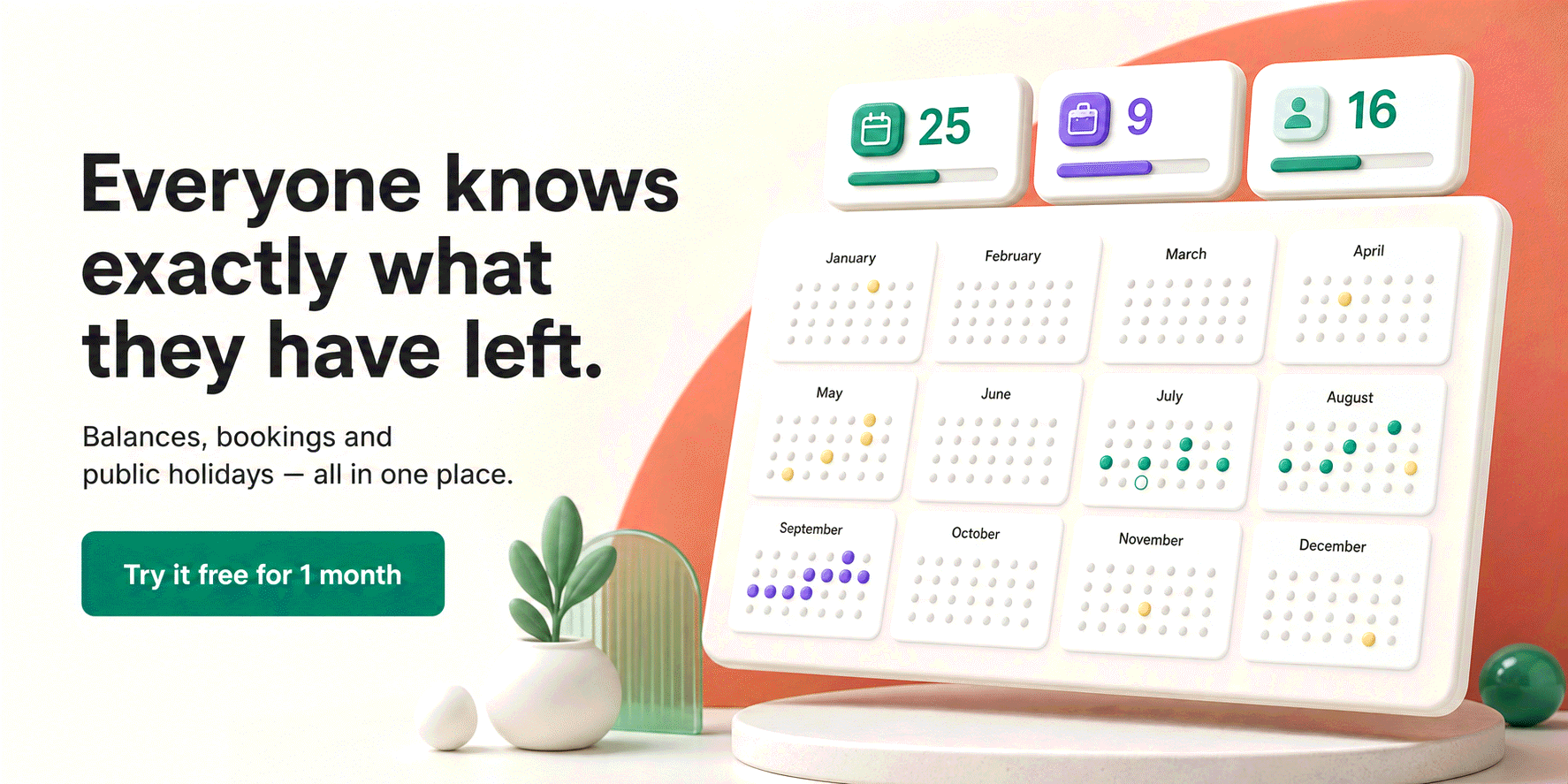
- The wall chart answers the only question that matters under FTO: who is off, when, and does anything clash. Department caps stop a whole team booking the same sunny week.
- Requests take seconds and leave a record. Book from a phone or Slack, approve in one click, and every decision is on file: the audit trail European law expects, without a single spreadsheet.
- Reports surface underuse. The per-person view shows who has taken the least this year, so "publish a minimum" becomes checkable instead of aspirational.
- Country rules are built in. Working weeks, national holidays for 45+ countries, and the statutory depth (Italian ROL, French RTT, Spanish convenios) that a "minimum plus flexible" policy has to sit on.
If you're weighing tools, start with our complete guide to leave management software, then use the buyer's guide to pick well.

Frequently asked questions
What is the difference between FTO and PTO?
PTO (paid time off) is a fixed annual bank of paid days, often combining vacation, sick and personal days, that employees draw down. FTO (flexible time off) removes the fixed bank: there is no set number of days, people take the time they need and are judged on results. Unlimited PTO and open vacation policy are other names for the same idea.
Is unlimited time off really unlimited?
In practice, no. Every flexible policy has an implicit ceiling set by workload, team norms and manager behaviour. That's exactly why the research keeps finding that people with unlimited policies take fewer days than people with a fixed allowance: with no benchmark, the safe answer is to take less. Good policies fix this by setting an explicit minimum instead of a maximum.
Is flexible time off legal in Europe?
Yes, with one non-negotiable caveat: EU law guarantees at least four weeks of paid annual leave that must actually be taken, not paid out (except when employment ends), and several countries go further. A European FTO policy is therefore "statutory minimum plus flexible extra on top", and the employer still has to record the leave. Untracked is not an option, unlimited or not.
Why do employees take less vacation under unlimited policies?
Three reasons come up in every study: guilt (no allocated days means no earned days, so every request feels like a favour), ambiguity (nobody knows what a normal amount is, so everyone undershoots the imagined norm), and signalling (in a culture that rewards visible effort, taking less reads as commitment). A published minimum and managers who take real holidays fix all three.
Do I still need leave tracking software with an unlimited policy?
More than ever. Without allowances to cap anything, the calendar is the only control you have left: you need to see who is off and when, avoid whole teams vanishing in the same week, keep the records European law requires, and spot the people taking too little before they burn out. What changes is what you track: coverage and underuse instead of remaining balances.
The bottom line
Flexible time off is a genuinely good idea wearing a misleading name: the value isn't "unlimited", it's "trusted". It works when the policy states a minimum instead of a maximum, when requests stay visible on a shared calendar, and when leaders model real rest. In Europe, add the legal floor: four weeks (or more) that must be taken and recorded, with flexibility layered on top. Bueggio HR handles the mechanics (no-allowance leave types, the who's-off wall chart, one-click approvals, underuse reports) for €1.30 per user per month, with a free first month and no card to try it on your own team.