Legitimate Reasons to Call in Sick (and How to Handle Them Well)
What counts as a legitimate reason to call in sick, from flu to mental health, what doesn't, how proof and pay rules differ across Europe, why working while ill costs more than the absence, and how absence management software keeps sick leave simple and confidential.
Legitimate reasons to call in sick include anything contagious (flu, colds, stomach bugs), migraines, infections, injuries and medical procedures, mental health conditions such as anxiety, depression and burnout, and emergencies involving the people you care for. A hangover, a sunny day or a courier delivery don't qualify. Proof and pay rules change with the country, so if you run a team: write the policy down, make reporting effortless, and keep the details confidential.
Calling in sick makes many people more anxious than the illness itself. Employees wonder whether their reason is "good enough" and rehearse the message; managers wonder what they're allowed to ask; and in the gap between the two, people drag themselves to work carrying a fever and a laptop. This guide settles both sides: what counts as a legitimate reason to stay home, how the rules differ across European countries, and how to handle sickness reporting so it stops being awkward for everyone.
What counts as a legitimate reason to call in sick
The honest test is simple: are you too unwell to do your job properly, or would going in make you (or others) worse? If yes, staying home is the professional choice, not the lazy one. The classic legitimate reasons:
- Flu, severe colds and anything contagious. The clearest case of all: one person's stoicism becomes five people's sick week. Stay home until you're past the contagious stage.
- Stomach bugs. Short, brutal and highly transmissible. Nobody wants you commuting, and food-handling or customer-facing roles often legally require you to stay away.
- Migraines and severe headaches. A real migraine is incompatible with screens, meetings and fluorescent light. Powering through produces nothing but errors.
- Infections that need treatment. If a doctor prescribed antibiotics or rest, the prescription is the answer to "should I go in?".
- Injuries and recovery from procedures. From a sprained back to day surgery: recovery time is medical time, not negotiable time.
- Anxiety and panic attacks. An acute episode is as disabling as any physical symptom. A day to stabilize and see a professional is legitimate sick leave.
- Depression. An illness, certifiable by a doctor like any other. The stigma is the problem; the absence is not.
- Burnout and acute stress. Recognized by the WHO as an occupational phenomenon. A team that burns people out and then questions their sick days is running a leak it refuses to see.
- Medical and dental emergencies. The abscess, the allergic reaction, the tooth that cracked at breakfast: emergencies don't book appointments.
- Emergency care for dependants. A sick child or a dependent parent in crisis. Many countries have specific leave for this; where they don't, decent policies treat it with the same respect.
What doesn't count
A hangover is self-inflicted, not sickness. "I just don't feel like it" is a signal worth listening to (of boredom, friction or burnout brewing), but it's a conversation, not a sick day. The weather, a match, a delivery window: that's what vacation days and flexible hours are for. The distinction matters because every fake sick day quietly taxes the colleagues who cover it, and erodes the trust that makes the legitimate list above easy to use.
The rules change with the country
Whether you need proof, when, and who pays: every country answers differently. That's worth knowing as an employee, and it's a real operational problem the moment your team spans borders. A sample of how differently Europe handles the same fever:
| Country | Proof required | Who pays, broadly |
|---|---|---|
| United Kingdom | Self-certification up to 7 calendar days, a doctor's fit note after that | Statutory Sick Pay at a flat weekly rate; many employers top up by policy |
| Italy | Doctor's electronic certificate to INPS from day one; the employee passes the protocol number to the employer, and must be home during set hours for medical checks | First days typically on the employer per the collective agreement, INPS from day four, most agreements top up |
| France | An arrêt de travail from the doctor, sent to the health insurance fund within 48 hours | Three waiting days before state daily benefits; employers complement after a year of seniority, many agreements do better |
| Spain | A parte de baja from the doctor, transmitted electronically to the employer since 2023 | Nothing by law for days one to three, 60% of the base from day four, 75% from day 21; collective agreements often complete the salary |
Two lessons hide in that table. For employees: check your country's rules and your collective agreement before you need them, not at 7am with a fever. For employers: a single "email your manager" policy can't be compliant in four countries at once, which is why country-aware tooling stops being a luxury the day you hire abroad.
How to report sickness properly
If you're the one calling in sick
Tell your employer as early as the policy asks, through the channel it names, and keep it to what matters: you're unfit for work, roughly how long you expect to be out, and anything urgent that needs a handover (two lines, not a shift from your sickbed). You don't owe anyone a diagnosis. Then actually rest: answering "just one quick thing" messages teaches everyone that your sick days are negotiable.
If you're the employer
Write the policy down: whom to notify, by when, through what channel, and what proof local rules require. Make the reporting itself effortless, because a feverish person facing a clunky process will either skip it (and your records rot) or come in (and infect the team). Never ask for the diagnosis; track patterns, not people, and keep return-to-work conversations about support rather than suspicion. Above all, watch your own behaviour when someone calls in: the team learns the real policy from the manager's tone, not the handbook.
Working while sick costs more than the absence
Presenteeism is the expensive twin of absence: people at their desks, too ill to work well. It never shows up in a report, which is exactly why it compounds. Research keeps reaching the same conclusion: UK studies such as Vitality's long-running workplace survey find employees lose roughly ten times more productive days to working while unwell than to actual sickness absence, and think-tank estimates put the total cost to the economy in the tens of billions per year. The mechanics are intuitive: illnesses last longer without rest, quality drops in ways that surface weeks later, contagion multiplies the original absence, and a culture of heroic sniffling teaches everyone that rest is weakness. A company that makes calling in sick easy isn't being soft; it's protecting throughput.
Where a leave tracker fits
None of the above needs software to be true, but software is what makes it stick. A dedicated tracker like Bueggio HR turns the policy into the path of least resistance:
- Sickness is its own leave type, separate from vacation: it doesn't touch the holiday allowance, and it can skip approval entirely, because sickness is notified, not negotiated.
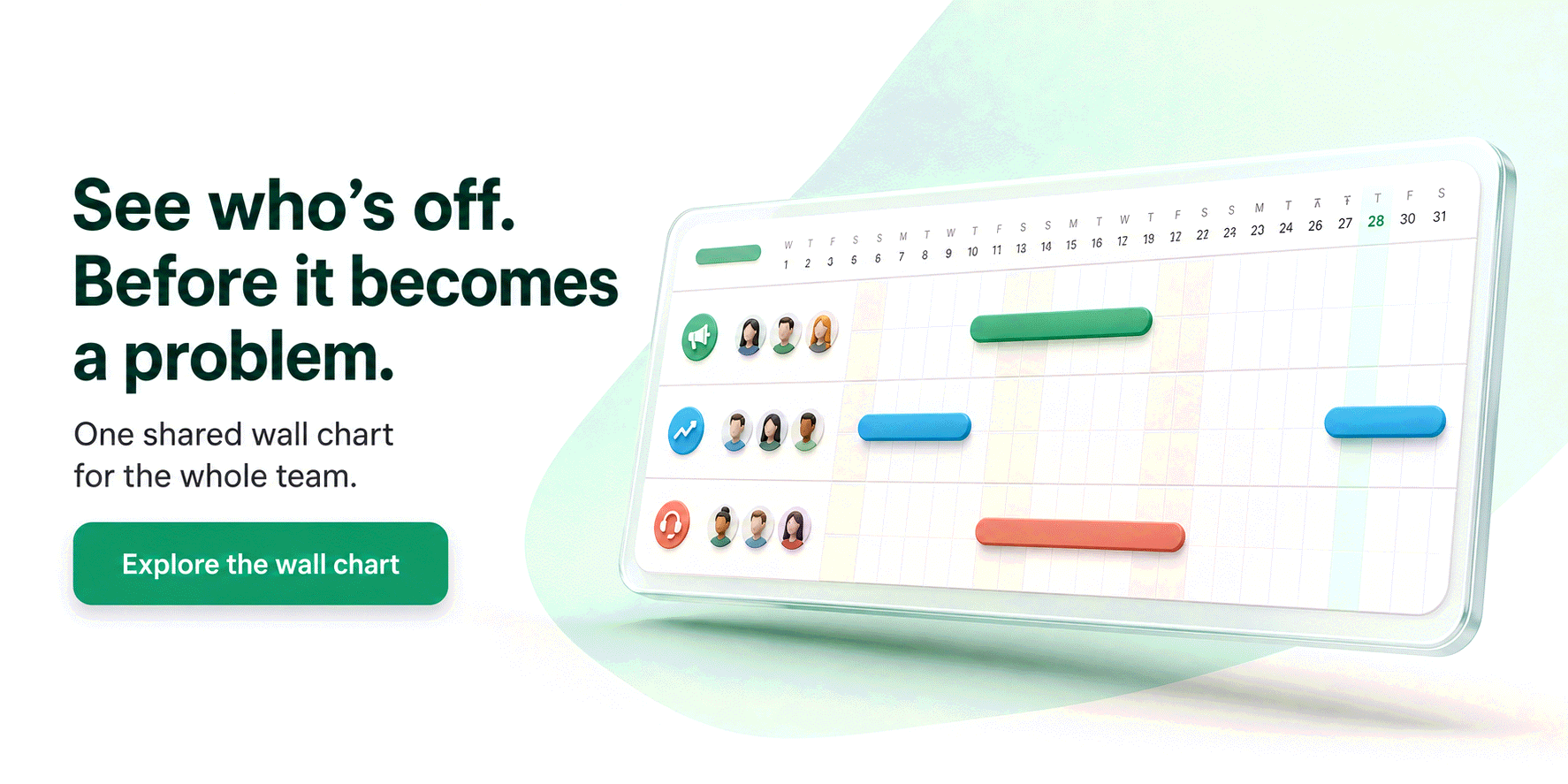
- Reporting takes seconds from a phone, which is where a sick person actually is. The manager gets a notification, the wall chart updates, and cover can be arranged before the 9:30 meeting discovers the gap.
- Certificates attach to the request when your country or policy needs them, instead of travelling by email. Italian rules go deeper: the INPS certificate number has a dedicated field, because that's how malattia actually works there.
- Confidentiality is structural. Notes and attachments are visible only to the people who must see them, the data lives on EU servers, and GDPR export and erasure are built in. A sick note is sensitive by inference; a medical certificate is special-category data under GDPR Article 9. That's a strange thing to keep in a shared spreadsheet.
- Patterns become visible without surveillance: reports show absence by team and period, so you notice the department that's quietly burning out while individuals stay individuals.
If you're still tracking sickness in the same spreadsheet as holidays (or not tracking it at all), start with our complete guide to leave management software, then use the buyer's guide to pick well.
Frequently asked questions
Do I have to tell my employer exactly what is wrong with me?
No. In most countries you only need to say you are unfit for work and roughly how long you expect to be off. The diagnosis stays between you and your doctor: in Italy, France and Spain the copy of the certificate the employer receives deliberately omits it. Health information is special-category data under GDPR, so the less of it that circulates in inboxes and spreadsheets, the better for everyone.
Is mental health a legitimate reason to call in sick?
Yes. Anxiety, panic attacks, depression and burnout are illnesses, and a doctor can certify them exactly like flu or a back injury. Teams that treat a mental health day as skiving push people into presenteeism, and the evidence says that costs the company far more than the absence would.
Can my employer refuse a sick day?
Sickness is notified, not approved: it isn't a holiday request a manager weighs against the calendar. What the employer can do is ask for the proof local rules allow, such as a fit note in the UK after seven days or a medical certificate from day one in Italy. A tracker that separates sickness from vacation makes that distinction obvious to everyone.
What is presenteeism and why should a small team care?
Presenteeism is working while too ill to work well. It looks free because nobody is marked absent, but studies consistently find it costs employers more than sickness absence itself: illness lasts longer, mistakes multiply, and one contagious hero can take out half the office. Small teams feel that harder than anyone.
How should a small company track sick leave?
Separately from vacation, with as little friction and as much confidentiality as possible: a sickness leave type that doesn't touch the holiday allowance, notification in seconds from a phone, optional certificate upload, and details visible only to the people who must know. That's the shape of a good leave tracker; our guide to choosing one walks through the rest.
The bottom line
If you're too ill to work well, calling in sick is the right call, and that includes your mental health. Know your country's proof and pay rules before you need them. And if you run a team: write the policy down, make reporting take seconds, keep the details confidential, and treat presenteeism as the cost it is. Bueggio HR handles the mechanics (sickness types, confidential notes, certificates, the who's-off wall chart) for €1.30 per user per month, with a free first month and no card to see it on your own team.